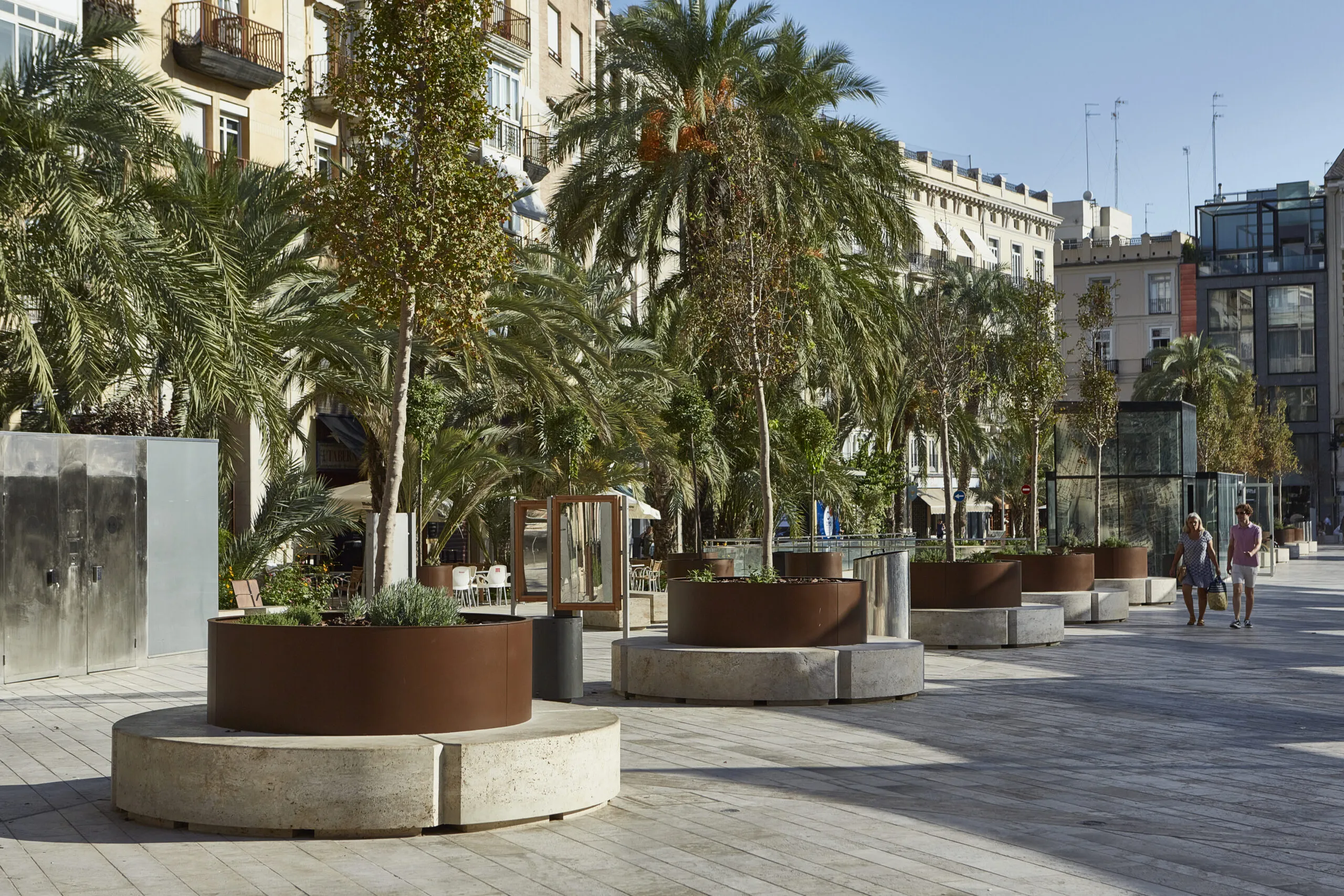
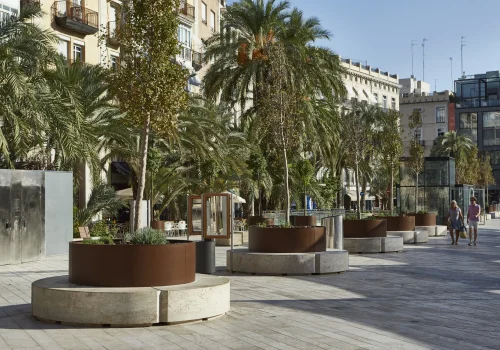
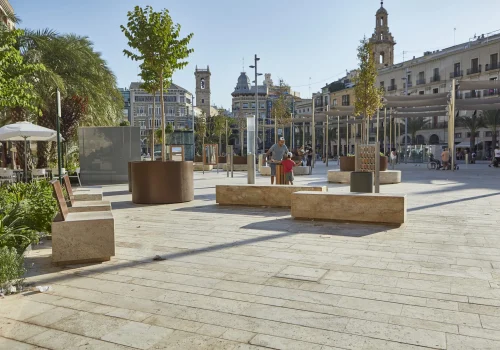
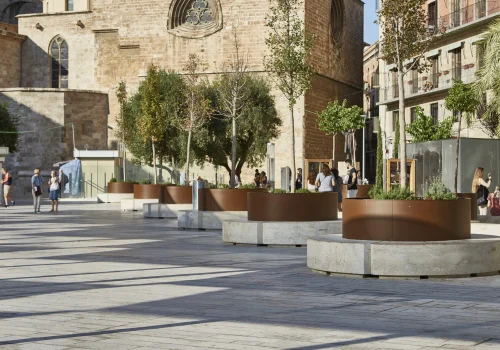
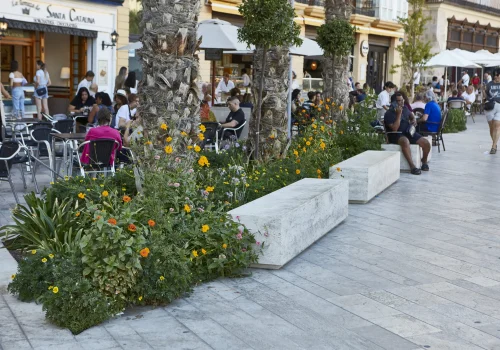
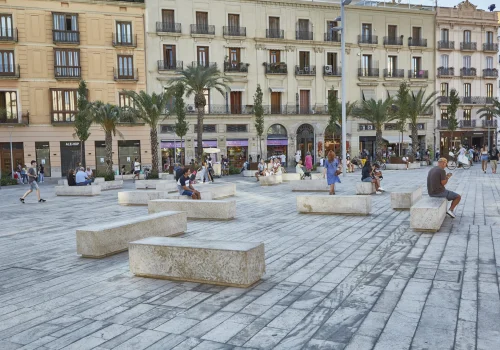
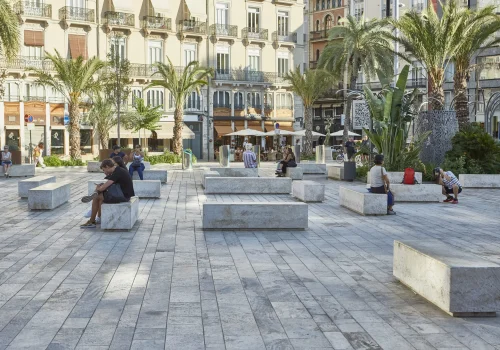
The project involved paving the 12,000 m2 space with travertine from Teruel and Almería, as well as creating all the furniture, such as benches, planters, and sculpture pedestals, in Almería travertine.
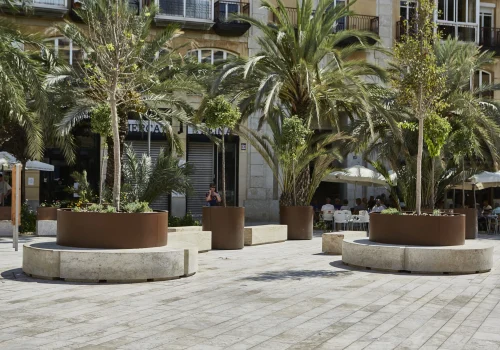
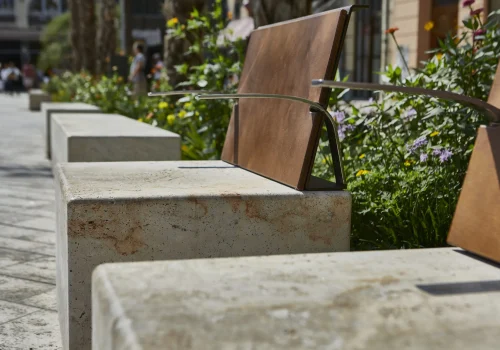
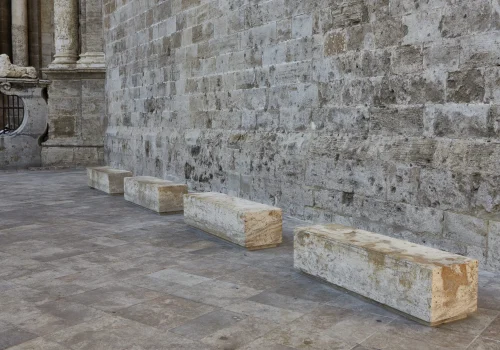
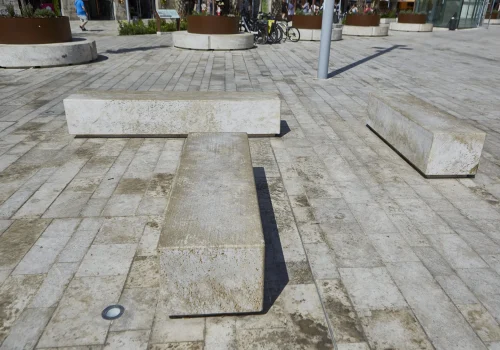
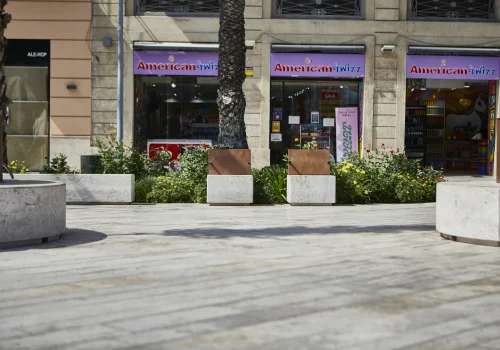
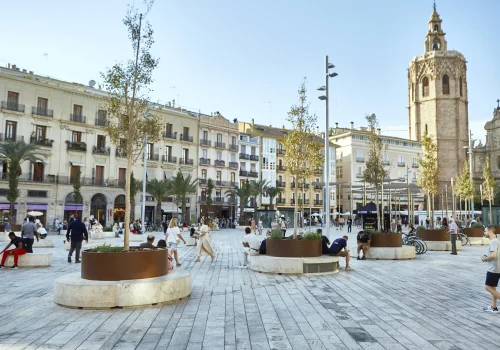
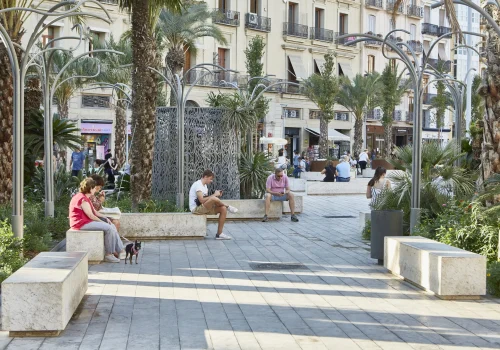
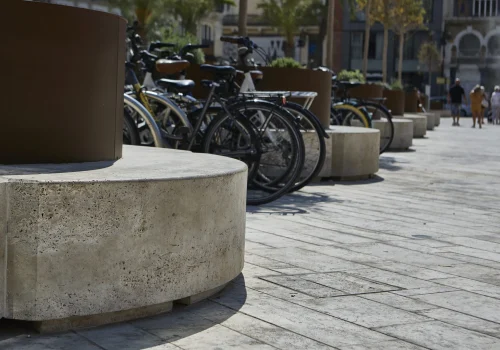
The furniture consisted of 23 circular benches measuring 2.80 meters by 2.60 meters, made up of four solid pieces forming an interior hollow where native vegetation was planted. In addition, 12 solid straight benches measuring 2.40 by 0.45 meters and 19 benches measuring 1.80 by 0.45 meters were placed in the middle of the plaza. In addition, 120 linear meters measuring 0.45 by 0.50 meters were created to form all the square’s straight planters. Finally, the statue pedestals, as well as the km 0 plaque, were also made of travertine from Almería.
The project applies sustainable criteria, using materials from nearby quarries in Spain, such as Almería and Teruel, as well as native or naturalized vegetation that requires little maintenance and water, and energy-efficient lighting. The space is partly funded by European funds, through IDAE (Institute for Energy Diversification and Savings of the Ministry for Ecological Transition), due to its significant reduction in the environmental impact of the space. As an example, this project, along with six other initiatives, will reduce energy consumption from 7,462,337.4 kWh/year to 2,767,793.15 kWh/year.
In turn, for the production of natural stone, 97% of the water consumed in the manufacturing process has been reused, while 100% of the excess material has been reused to create gravel and masonry stone
Alhama Travertine
The project involved paving the 12,000 m2 space with travertine from Teruel and Almería, as well as creating all the furniture, such as benches, planters, and sculpture pedestals, in Almería travertine.
The furniture consisted of 23 circular benches measuring 2.80 meters by 2.60 meters, made up of four solid pieces forming an interior hollow where native vegetation was planted. In addition, 12 solid straight benches measuring 2.40 by 0.45 meters and 19 benches measuring 1.80 by 0.45 meters were placed in the middle of the plaza. In addition, 120 linear meters measuring 0.45 by 0.50 meters were created to form all the square’s straight planters. Finally, the statue pedestals, as well as the km 0 plaque, were also made of travertine from Almería.
The project applies sustainable criteria, using materials from nearby quarries in Spain, such as Almería and Teruel, as well as native or naturalized vegetation that requires little maintenance and water, and energy-efficient lighting. The space is partly funded by European funds, through IDAE (Institute for Energy Diversification and Savings of the Ministry for Ecological Transition), due to its significant reduction in the environmental impact of the space. As an example, this project, along with six other initiatives, will reduce energy consumption from 7,462,337.4 kWh/year to 2,767,793.15 kWh/year.
In turn, for the production of natural stone, 97% of the water consumed in the manufacturing process has been reused, while 100% of the excess material has been reused to create gravel and masonry stone
Alhama Travertine
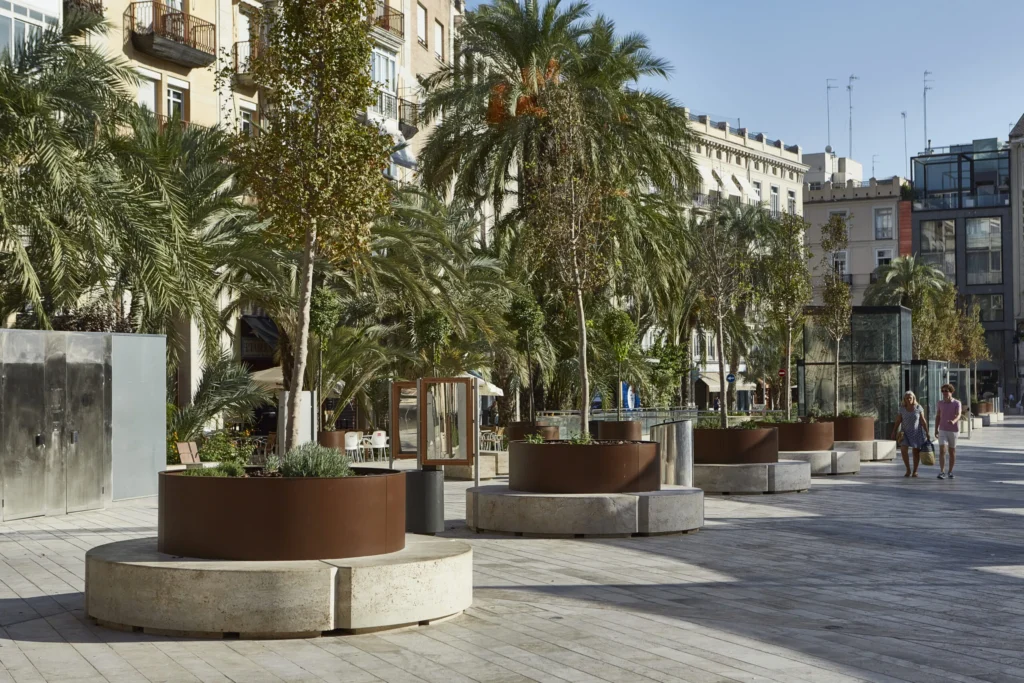
The project involved paving the 12,000 m2 space with travertine from Teruel and Almería, as well as creating all the furniture, such as benches, planters, and sculpture pedestals, in Almería travertine.
The furniture consisted of 23 circular benches measuring 2.80 meters by 2.60 meters, made up of four solid pieces forming an interior hollow where native vegetation was planted. In addition, 12 solid straight benches measuring 2.40 by 0.45 meters and 19 benches measuring 1.80 by 0.45 meters were placed in the middle of the plaza. In addition, 120 linear meters measuring 0.45 by 0.50 meters were created to form all the square’s straight planters. Finally, the statue pedestals, as well as the km 0 plaque, were also made of travertine from Almería.
The project applies sustainable criteria, using materials from nearby quarries in Spain, such as Almería and Teruel, as well as native or naturalized vegetation that requires little maintenance and water, and energy-efficient lighting. The space is partly funded by European funds, through IDAE (Institute for Energy Diversification and Savings of the Ministry for Ecological Transition), due to its significant reduction in the environmental impact of the space. As an example, this project, along with six other initiatives, will reduce energy consumption from 7,462,337.4 kWh/year to 2,767,793.15 kWh/year.
In turn, for the production of natural stone, 97% of the water consumed in the manufacturing process has been reused, while 100% of the excess material has been reused to create gravel and masonry stone
Alhama Travertine